The Grand Scheme. Rockin’ the Block. Demo.
(If SoundCloud isn’t playing nice please refresh the page.)
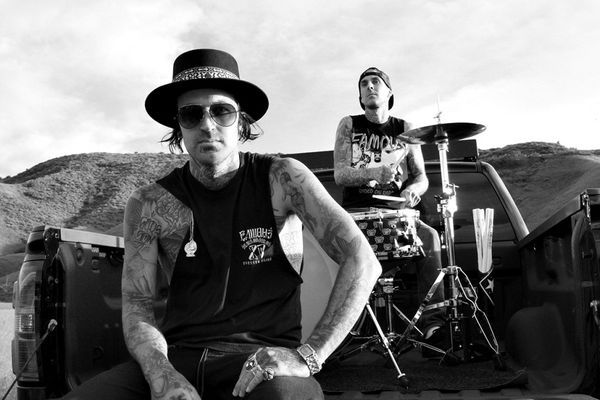
The dirtiest rock band in the world
Author reality 2.0
Authors of the future are small enterprises, just one person or perhaps two or three. But they include fan engagement specialists, licensors, new media development managers, public speakers, endorsement and bizdev VPs, and more. [The illusion of patronage]
— Seth Godin
The only point I’d disagree on is that this is today’s reality; the future will be far more intense …
Which part of artistic creation has value?
In the creative industries we tend to focus on art as the product being sold to our customers. It’s obvious, right? People buy CDs, theatre tickets and books; it’s where we make our money. But what if the customer is less interested in the output of our creative endeavours than the creator herself?
In an era where everyone is encouraged to be creator (marketer, retailer and distributor), but where so few are capable of creating spectacular art, I wonder whether it is the process that has value more than the output?
I can’t help but wonder whether the part of creation we can’t see, and can’t possibly understand, is ultimately the most desirable?
The stupidity of copy protection
I recently needed a simple partnership agreement for a band I’m working with. I grabbed one for a nominal fee from a national arts law organisation of which I’m a subscriber. It’s a good (enough) agreement, but the supplied PDF had Adobe’s security enabled so that it couldn’t have content extracted.
This is crazy. The organisation is happy to have the document copied by manually typing the thing into Word, but doesn’t want to make it easy for their customers by enabling cut and paste. I don’t get it.
What makes decisions like this even more bizarre is that I Googled “remove PDF copy protection” and in the top 10 results was a site that enabled the removal of the security restrictions simply by uploading the document.
The end result is the same … which begs the question, why?
Spotify is financial death by a trillion streams
Back in March I wrote a brief piece on the streaming of recorded music, The lunatics are advising the asylum, in which I noted:
These models will do for artists that which the iTunes store (unbundling the album) did for recording companies: financial death. Ironically it will be great for rights holders.
I held the view well before writing that post that streaming will turn recorded music into a nickel and dime game, which will only work for multinational aggregated rights owners. I’m talking about companies that own millions of songs and recordings, and not thousands let alone hundreds.
Since March we’ve seen a number of labels leave the Spotify ecosystem, and with good reason. The latest is Projekt Records.
There is an alternative to streaming services. One that reflects how people actually want to consume digital media and not how some in Silicon Valley think they should. (I’ll include armchair critics like Lefsetz in this category too.)
The alternative? That’s one I hope to let you all know about in the New Year.
The future of work
Seth Godin nails the future of work in his post, The forever recession (and the coming revolution), except of course he’s talking about the work that needs to be done today.
He writes:
Job creation is a false idol. The future is about gigs and assets and art and an ever-shifting series of partnerships and projects. It will change the fabric of our society along the way. No one is demanding that we like the change, but the sooner we see it and set out to become an irreplaceable linchpin, the faster the pain will fade, as we get down to the work that needs to be (and now can be) done.
It’s a slightly longer read that usual but one for which I suggest you make the time.
Seth Godin on author scarcity and souvenirs
Can’t remember the last time I blogged. Been way to busy with my head down sorting out some troubled business interests. It has been an object lesson in not investing emotionally in a business entity so that the necessary decisions can be made quickly, with prejudice.
Seth Godin blogged today (at the Domino Project) about one future many authors will face. He says that “the future of books lies in amateur authors, together with the few superstars with a big enough tribe or a big enough reputation to earn significant advances and royalties”. Has it been any other way?
He also wrote about scarcity, and understanding the business you are really in. He cited Rolex as an example: they’re in the business of time right? He suggests jewellery. He’d be right.
With information seemingly so freely available, what exactly are readers buying? The paper carton containing the ideas? Partly. Readers are really buying into the author. Just as the fans of bands invest in more than music, authors need to understand that their readers are really more interested in them than their ideas.
It’s all about the show folks.
Rethinking to-do lists
We all have stuff that needs to be done, and keeping it together is clearly difficult enough to warrant the existence of a gigantic to-do list industry.
Recently I stopped writing to-do lists, at least as most of us know them.
Instead I opted for writing anything that needs to be done directly into my diary. FWIW, I use BusyCal on OSX because of it plays nice with Google Apps and has local network integration.
In my mind there is no better to-do list than one that reminds us not only what needs to be done, but also when it needs to be done. To-do lists don’t really engender action–without time specifically allocated to a task they’re just a list after all, and there are never enough hours in the day …
Allocating specific time to do the work made all the difference for me. Importantly I now know when a task can actually be done; at the moment I’m about 4 weeks out on dealing with any discretionary client requests. Before the change it’d be hours of late night “catch up”. So this is also very much about taking control of my time.
It takes a little time to get used to moving from those lovely long lists that make us feel either incredibly important or totally overwhelmed (or both) to putting everything in your calendar but you’ll be glad you did.