Creativity Steve Jobs' on Hollywood, Silicon Valley and his greatest achievement What if Steve Jobs' greatest achievement was not the success of Apple? What if it was conquering two industries that have very little in common? This is not well enough understood.
Marketing An inexpensive marketing analytics tool to help you win any argument Marketers need to win the attention of not only their audience but the hearts and minds of the C-suite. This tool will help marketing teams of one do it.
Marketing Data ratios are a marketer's secret weapon There are many ways to segment your marketing data to measure program success. To better understand business impact, use ratios to bring context and meaning to your data.
Marketing Balancing cold hard reality and eternal optimism What does Harry Potter have to do with marketing? Turns out, plenty. Especially if you're focused on the wrong numbers.
Marketing How to develop unique value proposition in competitive markets Find a niche and build a product that solves the challenges specific to that vertical. It is very difficult to build a product for a horizontal market, let alone scale the marketing ($$$$$).
Technology Blockchain for new media content rights and creators Is the music industry learning, or not, from past mistakes resisting new technologies like blockchain?
Business What entrepreneurs can learn from a Formula 1 world champion With the United States Formula 1 Grand Prix upon us this weekend, entreprenuers wouldn't typically expect to get sage advice from a motor racing driver. In a recent interview with the BBC, multi-times World Champion Lewis Hamilton shared a few relevant thoughts.
Marketing When you think you don't have a marketing stack but it actually looks like this This is what a pretty simple marketing stack looks like nowadays. The idea that marketing "isn't technical" is remarkably inaccurate. Let's take a look.
Marketing The best marketing since 1984 Imagine you market one of the world's most iconic companies. The CEO says, "I need you to persuade the world to buy a product they don't want."
Marketing Why stability matters to marketing In this week's episode of the SaaStr podcast, Shan Sinha explains how iterating on their business model placed a huge tax on the organization, especially the growth function.
Principles This guy changed my life and can change yours too I'm always thinking. Shower, driving, working, writing this ... It's not healthy. Here's what I did about it, how it saved my life, and could save yours.
Creativity It's time to redesign the open plan office I work in an open plan office. Not one executive office, just a big space circled by meeting rooms. Here's how Frank Lloyd Wright's work became corrupted.
Technology Blocked by the Great Firewall of China A small claim to fame, the time when I was blocked by the Great Firewall of China. Exactly how controversial were my opinions?
Tunes Giuseppe Ottaviani live performance on A State of Trance Watching Armin van Buuren geek out to this live performance from Giuseppe Ottaviani is pretty cool.
Principles A few things I hold to be true These are the truths I hold to be true. They're personal to me and how I live my life. You should have your own. You will, at least, know where I'm coming from.
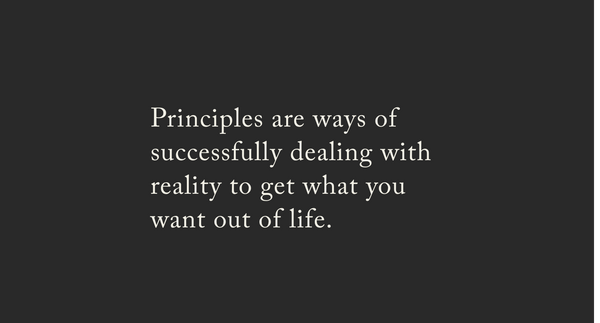
Principles Principles by Ray Dalio I'm currently reading Ray Dalio's new book Principles. Rather than write a review—for a book already reviewed numerous times—I'll update this post as I read.
Principles Vex Robotics at Willow Glen Middle School I have seen first hand how local communities impact the lives of students outside the classroom. I'm proud to mentor my local school's robotics team.
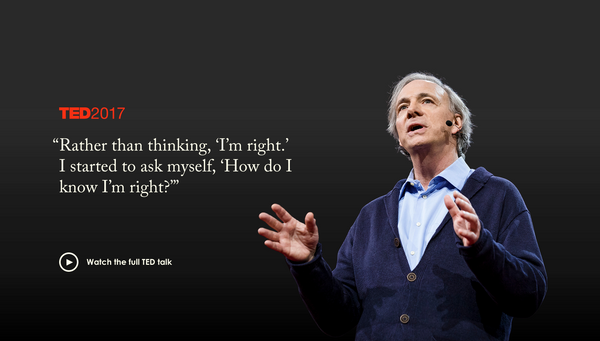
Principles How do you know you're right? Ray Dalio updates Principles. He discusses how to test the validity of what we hold to be true.
Tunes Listening to #ASOT831 Great new release this week from Above & Beyond, called My Own Hymn. Another high velocity episode of the greatest trance radio show on the planet.
Creativity Why I migrated from WordPress to Ghost CMS WordPress is an amazing project and I happily blogged with it for a long time. In this post I explain why I switched to Ghost for my personal blog.
Business Listening to Masters of Scale feat. Sheryl Sandberg Great scale leaders know how to pivot. Every day, there are new competitors, new threats, new opportunities. There’s no simple, straightforward set of marching orders.
Business Listening to Masters of Scale feat. Mark Zuckerberg If you’re Steve Jobs, you can wait for your product to be perfect. For everyone else, if you’re not embarrassed by your first product release, you’ve released it too late.
Business Listening to Masters of Scale feat. Brian Chesky If you want your company to truly scale, you first have to do things that don't scale. Hand-craft the core experience. Serve your customers one-by-one. Then figure out how and what to scale.
Haiku Issa: Winter seclusion I enjoy this poem for the lesson it teaches about patience. It is often in these moments, listening "to the rain in the mountain," we learn a great deal about ourself.
Haiku Basho: Summer grass The samurai found an honorable death in battle. In Basho's poem, the futility of our efforts becomes plain. All we have are our actions in any given moment.